What is a torque screwdriver?
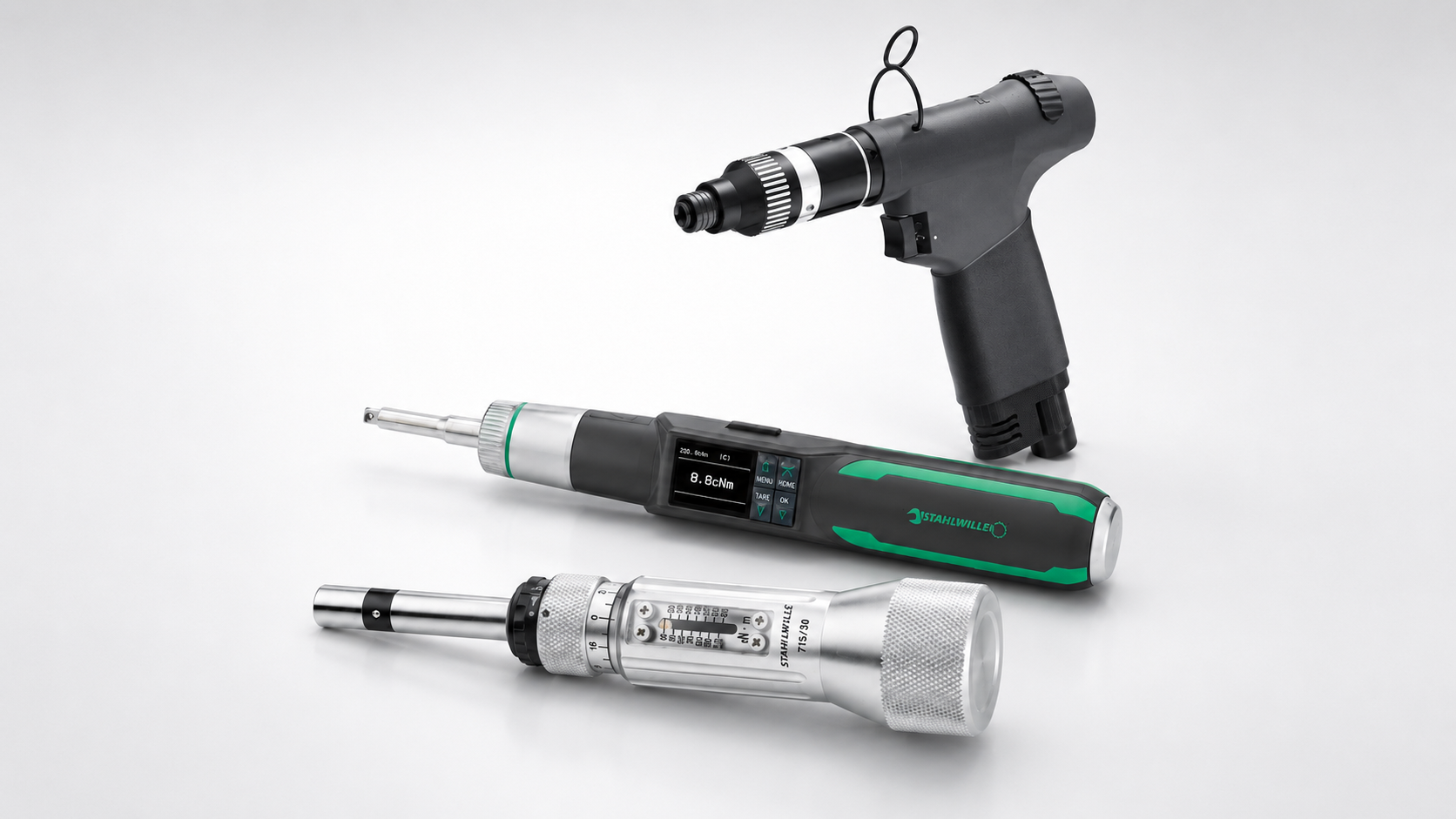
A torque screwdriver is a tool that allows for the precise application of the correct torque value to a screw connection. It ensures a durable and secure connection, preventing damage caused by applying too little torque, while also protecting the connection from damage resulting from applying too much torque during tightening. Torque screwdrivers are used for applications requiring low torque values, for precision work that is sensitive to damage resulting from improper torque application. Manual torque screwdrivers, in both mechanical and electronic versions, allow for precise tightening of joints in the range from 0.02 Nm to 15 Nm, and in the pneumatic version, up to 150Nm.
Practical Applications of Torque Screwdrivers
Torque screwdrivers are widely used in every industry, and their most common applications include:
Assembly processes they perform exceptionally well on production and assembly lines for a wide variety of products, enabling the quick, easy, and safe application of often very low torque values, that would be impossible to achieve with other tools. Hand-held torque screwdrivers such as those from the TORSIOMAX series, eliminate the risk of damaging the joint thanks to the use of precision slip clutches, which significantly speeds up the assembly process and reduces the risk of operator error, while ensuring very high precision (±6%) for the joints being made.
In turn, the use of pneumatic torque screwdrivers enables mass production, which would be impossible with manual tools. Pneumatic torque screwdrivers are equipped with precision cut-off clutches, ensuring that torque is applied with high accuracy of +/-10% and leaving the operator in no doubt as to whether the joint has been made correctly. Pneumatic torque screwdrivers also allow for the application of high torque values up to 150 Nm – thanks to the use of special reaction arms that protect the operator, while ensuring comfort and ergonomic working conditions. A good example in this regard are the pneumatic torque screwdrivers from DOGA’s DESI / DSEL series.
Another advantage is that the torque is adjusted using a torque tool tester – which prevents accidental or unauthorised changes to the torque value, thereby eliminating one of the greatest risks in the assembly process. https://torqueshop.eu/pneumatic-screwdrivers
Quality control process– for verifying completed fasteners – for these types of tasks, both mechanical and electronic torques scredrivers can be used. For example, mechanical screwdrivers with allow for a quick check to see if the minimum required torque was applied to a given fastener, while electronic screwdrivers guarantee 1% measurement accuracy, along with the ability to save measurement results to internal memory and download them later.
Research and prototyping – BMS electronic torque screwdrivers, such as those from the MS or MST series, are ideal for this purpose. These are high-end torque screwdrivers characterised by 1% measurement accuracy in both clockwise (CW) and counter-clockwise (CCW) directions. Thanks to the TRACK, PEAK, and PRESET functions, operator can measure torque in real time, determine the maximum allowable torque for a given joint, and precisely identify the torque at which the joint breaks. All measurement results can be saved to the screwdriver’s internal memory and then downloaded to a PC using software provided free of charge by the manufacturer. All information about this series is available at electronic torque screwdrivers.
What should you look for when choosing a torque screwdriver?
There are several important criteria that a user must consider when choosing a torque screwdriver that suits their needs:
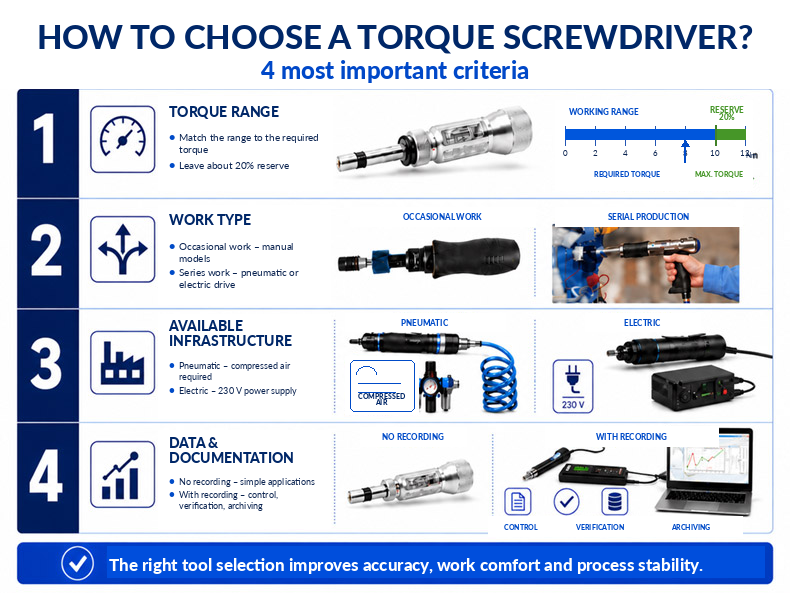
- The torque range of the torque screwdriver – does it cover the torque the user needs to apply, and is the maximum torque that the torque screwdriver can achieve at least 20% greater than the maximum torque the user plans to apply? This will ensure trouble-free operations and extend the screwdriver’s life span.
- The type of process for which the torque screwdriver will be used – will it be used sporadically – e.g., only a few times a day to perform specific assembly tasks or during quality control – in which case manual torque screwdrivers (mechanical or electronic) can be used successfully – or will it be used very intensively, e.g., in a mass production, assembly process – in which case it is essential to use pneumatic torque screwdrivers or electric torque screwdrivers.
- Existing Infrastructure - When selecting electric or pneumatic torque screwdrivers, it is important to consider the existing infrastructure and operating costs – as a rule, pneumatic torque screwdrivers are cheaper to purchase but require access to a compressed air supply and maintenance of the supply system, to keep in good working condition, to ensure the required air pressure necessary for their proper operation. This can generate additional costs during screwdriver exploatation. Meanwhile, electric torque screwdrivers, although typically more expensive to purchase, have only one requirement – access to a 230V power supply.
- The need to collect process data – if the only requirement is to achieve the correct torque value on the fasteners, without the need for documentation, then the best choice would be standard mechanical torque screwdrivers. But if it's necessary to document and save data for the applied torque value it is necessary to use more advanced solutions, such as electromechanical torque screwdrivers or electronic torque screwdrivers.
Calibration and Maintenance of a Torque Screwdriver
All torque screwdrivers both mechanical and electronic, as well as other hand-held torque tools, in accordance with the guidelines of ISO 6789:2017, are subject to mandatory periodic calibration - every 5,000 cycles or every 12 months.
Mechanical torque screwdrivers are not complex tools and have no special maintenance requirements, however, for electronic torque screwdrivers, it is important to ensure that the cable connecting the screwdriver to the readout unit remains in good condition and to pay attention to the device’s display to prevent accidental damage.
The situation is different for pneumatic or electric torque screwdrivers, in this case, the ISO 6789:2017 standard does not apply, and each manufacturer determines its own requirements regarding the frequency of calibration. Maintenance requirements are also more extensive than for
mechanical or electronic screwdrivers. For pneumatic torque screwdrivers, it is necessary to ensure the air supply system is in good condition, maintain a stable air supply pressure, and ensure proper lubrication of the mechanism by using tool oilers.
Electric torque screwdrivers require periodic inspection and lubrication of the tool’s gearbox,careful handling of power cords, selection of a tool with sufficient maximum torque capacity for the joint being made, and a properly planned operation process and frequency - to avoid overheating and motor damage.
The Most Common Mistakes in Selecting and Using Pneumatic Screwdrivers
Choosing the right pneumatic torque screwdriver is by no means an easy task, just as with other
torque tools, it’s easy to make a few mistakes:
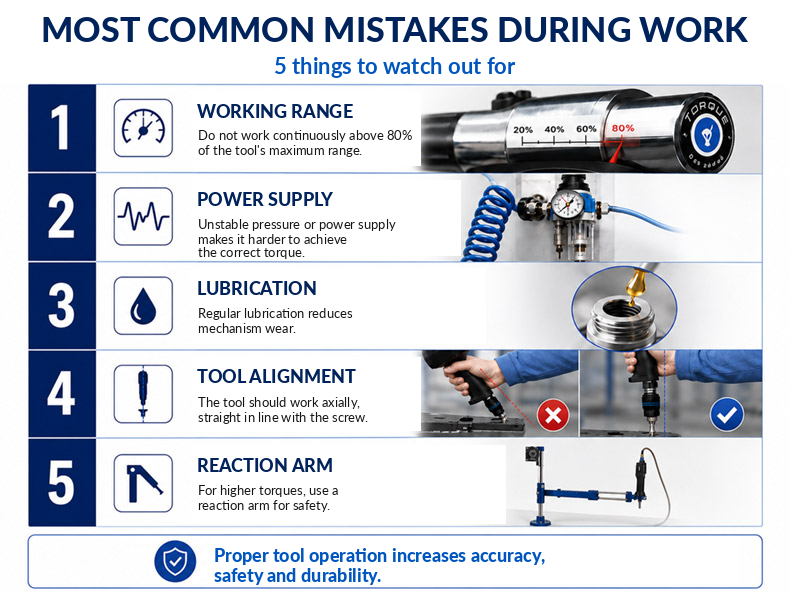
- Incorrectly selected torque range for the torque screwdriver– the screwdriver operates continuously at torques exceeding 80% of its maximum range, which leads to increased wear on the mechanism and raises the risk of the tool becoming discalibrated.
- Unstable air supply– the compressed air system operates erratically, causing fluctuations in supply air pressure, which affects the tool’s ability to achieve the set torque value.
- Lack of lubrication – keep in mind that a pneumatic torque screwdriver requires a small amount of lubricant to be applied at the air inlet, which protects the mechanism from excessive and accelerated wear; for this purpose, use professional lubricators designed specifically for use with torque screwdrivers.
- Incorrect positioning of the torque screwdriver during the tightening process – ensure that the torque screwdriver is in axis with the screw being tightened, the greater the deviation from the screw’s axis, the higher the risk of measurement error. Improper positioning of the screwdriver also leads to accelerated wear of the mechanism and shortens the life span of the torque screwdriver
- Failure to use an appropriate reaction arm – straight-style pneumatic torque, when operating at torques above 5 Nm, should be mounted on reaction arms specifically designed for this purpose. This ensure the axial alignment of the screwdrivers with the joint being tightened and, most importantly, protect the operator’s health. Failure to use an appropriate reaction arm results in centrifugal force being transmitted directly to the operator’s wrist and may cause injury.
When should you use a torque screwdriver?
Torque screwdrivers are worth using wherever:
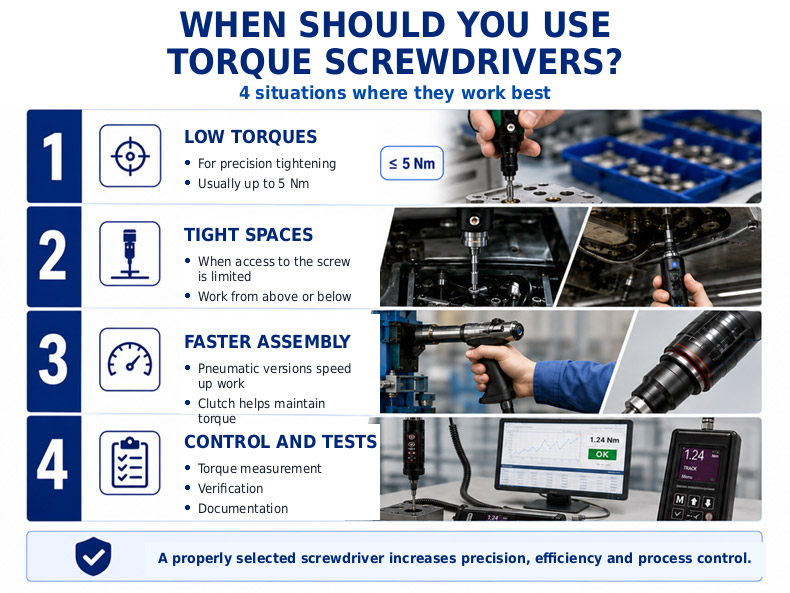
- We need to apply a precisely specified torque value, especially where that value does not exceed 5 Nm. Under such conditions, using a standard torque wrench would be inconvenient and would significantly increase the risk of incorrect torque application.
- A torque screwdriver also works perfectly on all fasteners in tight spaces with limited access – for example, where access is only possible directly from above or below the screw.
- Pneumatic or electric torque screwdrivers are also worth using to speed up production, the pneumatic drive significantly accelerates the assembly process, and the precise shut-off clutch ensures accurate application of the required torque value.
- Electronic torque screwdrivers are ideal for research and prototyping work – where it is necessary to experimentally determine the required torque value for a joint or to verify design assumptions, as well as during quality control of completed joints.
`