


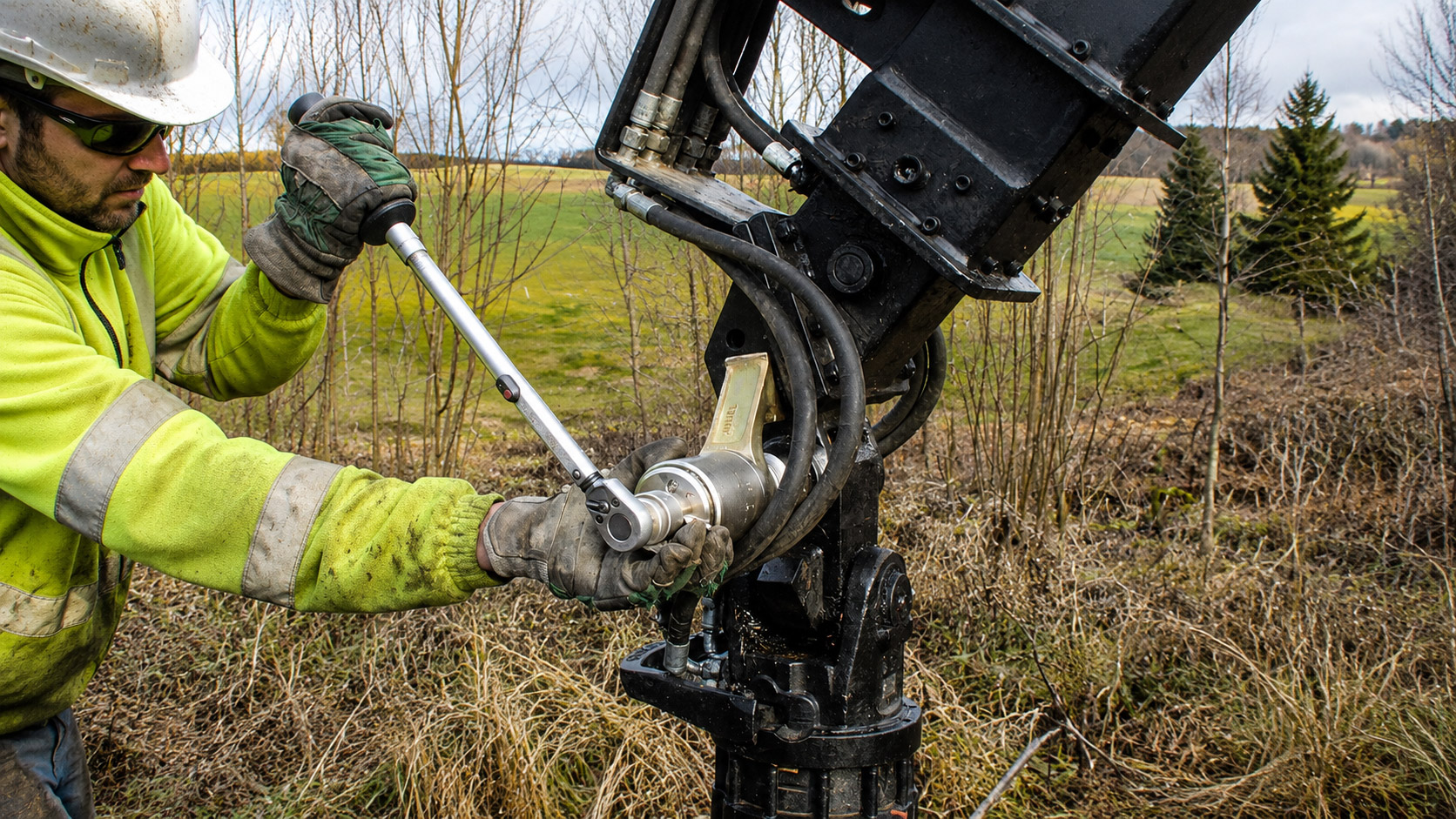
What is a torque multiplier?
A torque multiplier is a torque tool designed for working with high torque values. It is used wherever high torque is required – typically in excess of 1000 Nm, and where the use of a standard torque wrench is impractical, for example due to the length of the wrench’s arm – wrenches rated above 1,000 Nm are 120 cm or longer, whilst models with a torque rating of 1,500 Nm or more require the use of additional extensions to achieve such high torque values. The compact size of torque multipliers also makes them easier to use when working at height and in hard-to-reach places. The torque multipliers in our range are available from 540 Nm up to 12,000 Nm, but we can also supply models with even higher torque – up to 50,000 Nm – on special request.
How does a torque mutliplier work?
A torque multiplier is a specialised torque measurement tool based on the use of a planetary gear system, driven by a hand-operated torque wrench. The torque applied at the input of the multiplier is multiplied by the planetary gear system. In this way, by applying a relatively low torque value at the input of the multiplier, the user can achieve a very high torque value directly at the bolted joint. The torque multiplier ensures a constant and unchanging gear ratio, so the user can be certain that by applying a specific torque value at the input, they will obtain a precisely defined torque value at the output of the multiplier.
Construction of a torque multiplier
Every torque multiplier consists of six basic components:
- Housing – protecting the internal planetary gearbox
- Planetary gearbox
- Reaction arm
- Input adapter
- Socket driver
- Overload protection
Housing – its main purpose is, of course, to protect the planetary gearbox and ensure stable operating conditions
Planetary gearbox – this is the most important component of any torque multiplier; it provides a constant, unchanging gear ratio, precisely multiplying the applied input torque, and enables very high torque values to be achieved at the bolted joint
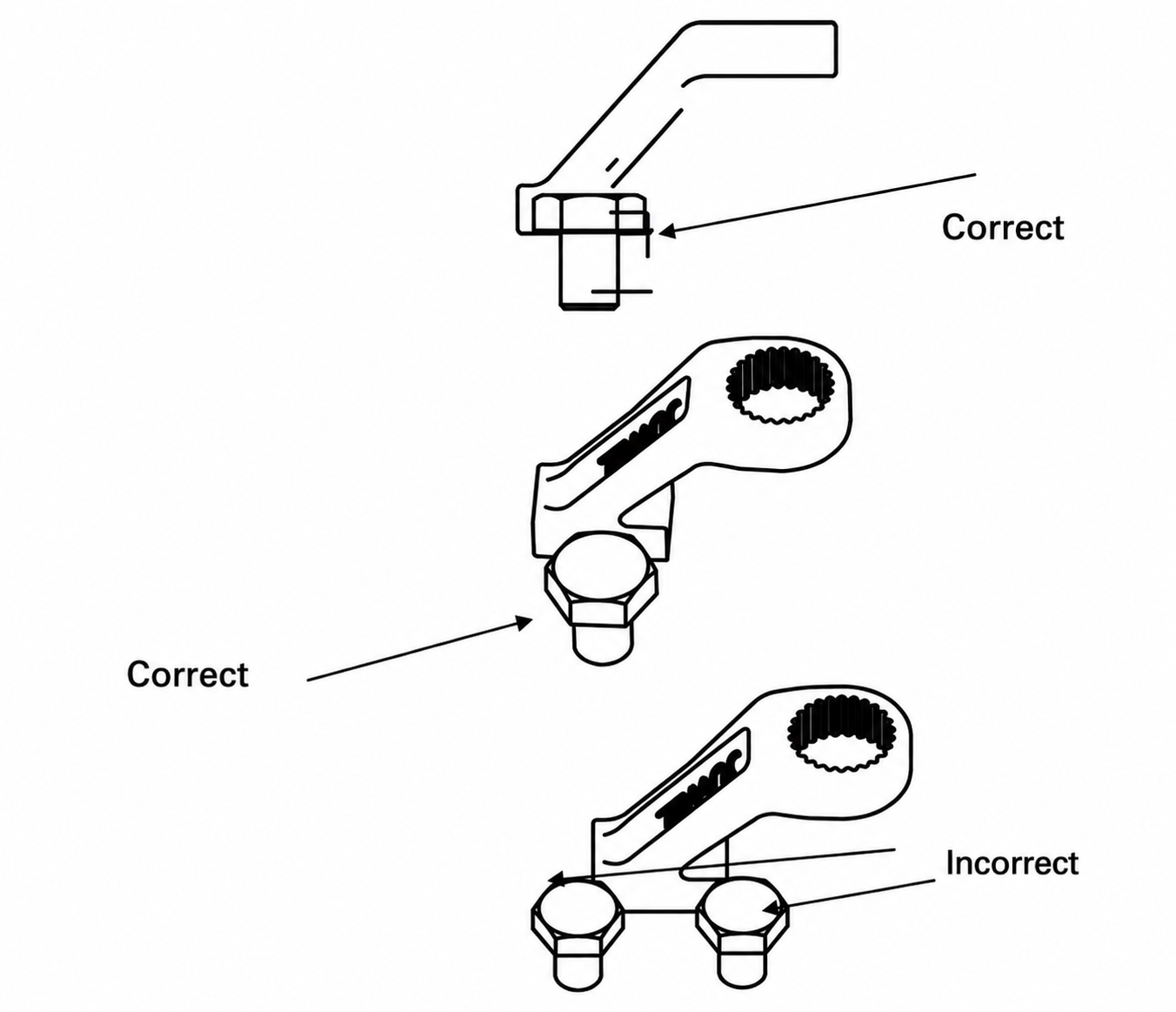
Reaction arm – a very important component of any torque multiplier. It provides a fulcrum and enables the safe use of the torque multiplier. Without a reaction arm, no torque multiplier will function.
Input adapter – enables a preliminary torque value to be fed into the multiplier
Socket adapter – allows a socket suitable for the user’s needs to be fitted
Overload protection – a very important component of the multiplier – protects the planetary gearbox from damage caused by an excessively high input torque
Types of torque multipliers
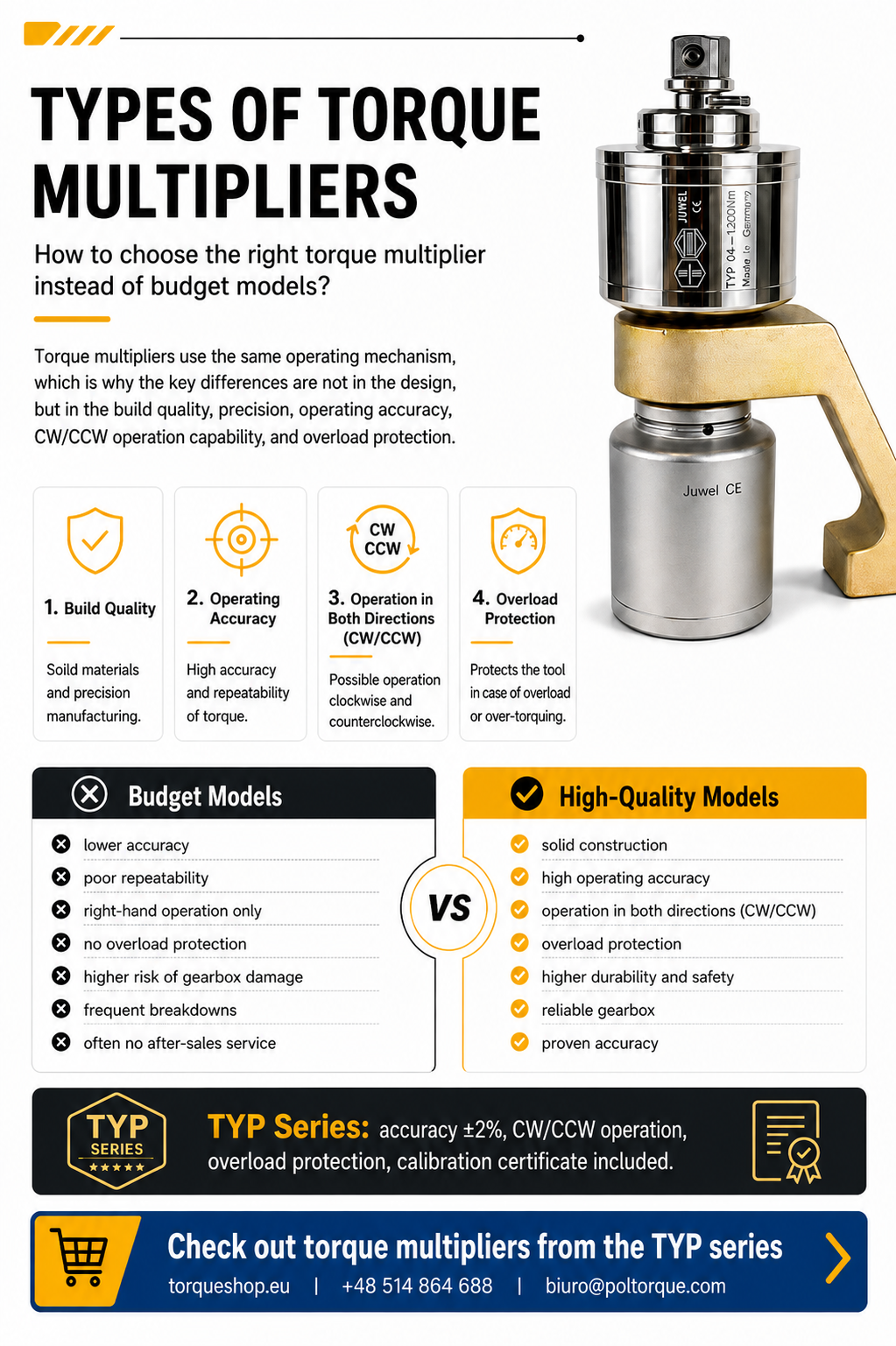
Torque multipliers essentially operate on the same principle, and it is difficult to categorise them based on their design. They can instead be distinguished by their build quality, operational precision, ability to operate in one or both directions (CW/CCW), and the inclusion of an overload protection mechanism.
Unfortunately, price is a good indicator of a torque multiplier’s quality – these are somewhat more advanced tools requiring precise manufacture, and as such, high-quality models are usually twice as expensive as budget models. We advise against purchasing cheap torque multipliers, as their accuracy is usually not verified by any documentation; they have a poor torque conversion ratio – which necessitates the use of a higher input torque value; they do not operate in reverse; and, most importantly, they lack any overload protection, which makes them highly susceptible to gearbox damage. Cheap models are usually ‘disposable’ tools, the servicing of which is uneconomical and costs more than buying a new tool.
All the models in our range are robust, high-quality tools. They are fitted with overload protection to safeguard the gearboxes from damage and can operate in both clockwise and anti-clockwise directions – particularly useful when loosening fastenings. The TYP series torque multipliers are characterised by very high accuracy of +/-2% and are supplied complete with a calibration certificate.
Torque multipliers and torque wrenches – how do they differ?
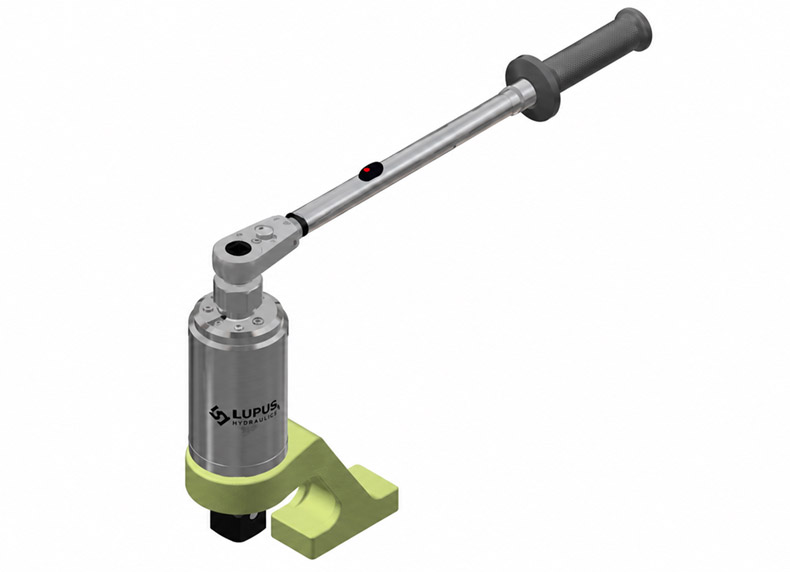
Torque multipliers and torque wrenches, although they serve the same purpose – namely, tightening connections to the correct torque value – are, at the same time, very different tools. Below, I outline a few key differences between these tools.
Torque wrenches are based on a different type of mechanism – spring-loaded or rod-type, or, in electronic versions, they use a strain gauge transducer – whilst torque multipliers utilise a planetary gear mechanism.
Torque multipliers require a solid support from the reaction arm whilst in operation – it is not possible to use a torque multiplier without locking the arm, which must be firmly supported against another bolt or structural component; otherwise, the multiplier would rotate continuously about its own axis. In the case of torque wrenches, there is no need to lock them in place whilst tightening.
Torque multipliers – at least the high-quality ones – are fitted with overload protection mechanisms to safeguard the gear mechanism. Thanks to the overload protection, a robust torque multiplier is effectively resistant to damage resulting from exceeding the maximum permissible torque value – a broken safety mechanism can be quickly replaced and the tool is ready for use again. Torque wrenches do not have such safety mechanisms – as a result, applying a torque exceeding the maximum permissible range for a given wrench model will result in its damage or even destruction
Dimensions – the largest torque wrenches currently available as standard on the market allow joints to be tightened to a torque of 3,000 Nm. To achieve such a high torque, it is necessary to use two or even three extensions fitted to the wrench handle; as a result, the weight of the wrench exceeds 10 kg, and the length of the entire wrench can range from 2.5 to as much as 3 metres! Whereas torque multipliers are usually relatively compact – for example, the TYP-03L multiplier, with a maximum torque of 5,400 Nm, weighs just 7.5 kg and is 37.5 cm tall! Check out the JUWEL TYP-03L series 1460–5400 Nm mechanical torque wrench.
When should a torque multiplier be used?
Torque multipliers are ideal tools for use wherever:
- The user needs to apply a high torque that cannot be achieved using standard torque wrenches.
- A bolted joint needs to be tightened in a confined or hard-to-reach space (e.g. at a great height) – and the use of a standard torque wrench is impossible due to lack of access or for the user’s safety.
- Wherever the purchase of an electric or cordless torque wrench is not economically viable due to the costs involved.
- For torque verification – the torque multipliers in our range can be successfully used to verify that the minimum torque required for a given joint has been applied. Unlike standard cordless and mains-powered torque wrenches, they allow you to confirm whether the required minimum torque has been applied to a given joint without damaging the joint that has already been made.
How to choose a torque multiplier?
Just like any other tool, torque multipliers should be selected to suit the requirements of the specific application.
The torque range of the multiplier should be at least 20 per cent greater than the maximum torque required at the joint for which it is to be used.
It is important to choose torque multipliers that have overload protection – cheap models lack this protection and are therefore highly susceptible to gearbox damage, which is uneconomical to repair.
It is equally important to check the gear ratio for a given model – a low gear ratio forces the use of a torque wrench with a higher torque setting, which increases the risk of accidental damage to the gearbox, particularly in budget models that lack overload protection.
An additional advantage is the ability of the torque wrench to operate in both clockwise and anti-clockwise directions; good models operate in both directions, which is very useful when it is necessary to loosen connections that were previously tightened with high torque.
How do you use a torque multiplier?
To use a torque multiplier correctly, you must follow a few basic rules; adhering to these ensures that the correct torque value is achieved and that the operation is safe.
- Ensure that the torque multiplier is correctly positioned – aligned axially in either a vertical or horizontal position.
- Ensure that the reaction arm is correctly positioned – the foot of the arm should rest against an adjacent bolt or other structural element to ensure a stable point of support for the torque multiplier.
- Ensure that the torque you wish to apply does not exceed the maximum permissible torque for the torque multiplier in question.
- Only use a torque wrench to drive the torque multiplier! Do not use ordinary ratchet spanners or power tools! Only the use of a torque wrench ensures that the precise torque value is achieved.
- Remember that the torque wrench you use to tighten the multiplier must be in good working order and have a valid calibration certificate – only such a wrench ensures that the required torque value is achieved with precision.
- Refer to the torque table – this document specifies the correlation between the input torque and the resulting output torque
- Remember to use original overload protection devices – only such devices have a precisely set breaking torque and protect the gearboxes from damage
The most common errors when using a torque multiplier
The most common errors when working with torque multipliers stem directly from a failure to follow the recommendations set out in the previous section:
- Incorrectly selected torque range for the multiplier – this prevents the required torque from being achieved at the joint, or forces the unit to operate continuously at the upper limit of the range.
- Incorrect locking of the reaction arm – risks damage to the torque wrench or injury to the user
- Using faulty torque wrenches with the torque multiplier – the accuracy of the wrench directly affects the torque achieved at the bolted joint
- Using impact or electric wrenches with the torque multiplier – torque multipliers are designed to work only with manual torque wrenches! Using unsuitable tools with the drive may damage the torque multiplier.
- Using non-original overload protection devices – only original overload protection devices have correctly calculated breaking torques and protect the gearboxes from damage.
- Using torque multipliers without documentation – the absence of a certificate and a torque table indicates that the multiplier is of rather poor quality and that it is not possible to precisely determine the torque value achieved
How should you look after a torque multiplier?
A well-chosen torque multiplier will serve the user reliably for many years. To maximise the tool’s service life, remember to store it properly – ideally in the dedicated packaging it came in when purchased – and to clean the housing after using the torque multiplier in harsh conditions. It is also important to use genuine accessories – dedicated reaction arms and overload protection devices. You should also remember to use only fully functional torque wrenches to drive the torque multipliers and never use any other tools to drive them – especially impact wrenches!
Adhering to the operating guidelines will ensure the longest possible service life and reliable operation of every torque booster.