


What are torque tools?
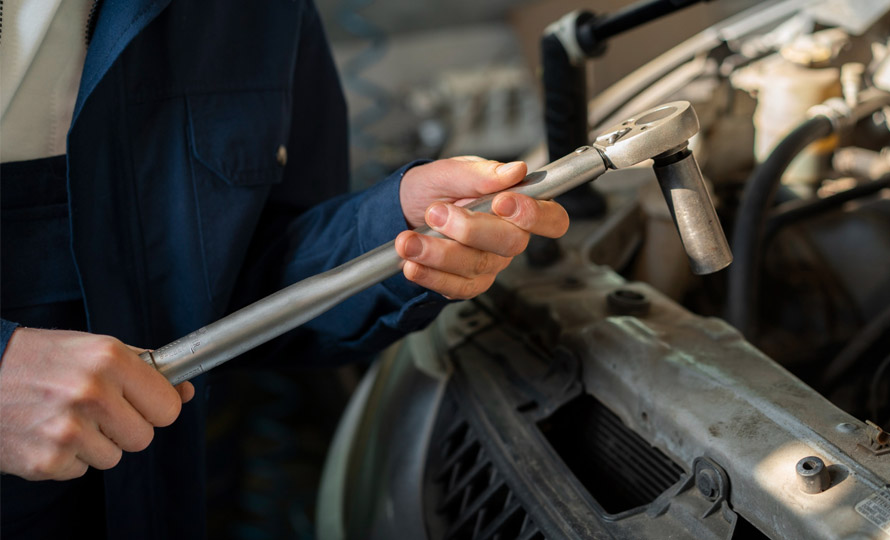
Torque tools comprise a very wide range of tools designed primarily for the precise application of a specific torque value to screw connections, but also for inspecting existing connections, or for research and laboratory work - to analyze the torque already applied or determining the required torque value for a given connection.
How does torque work and why is it important?
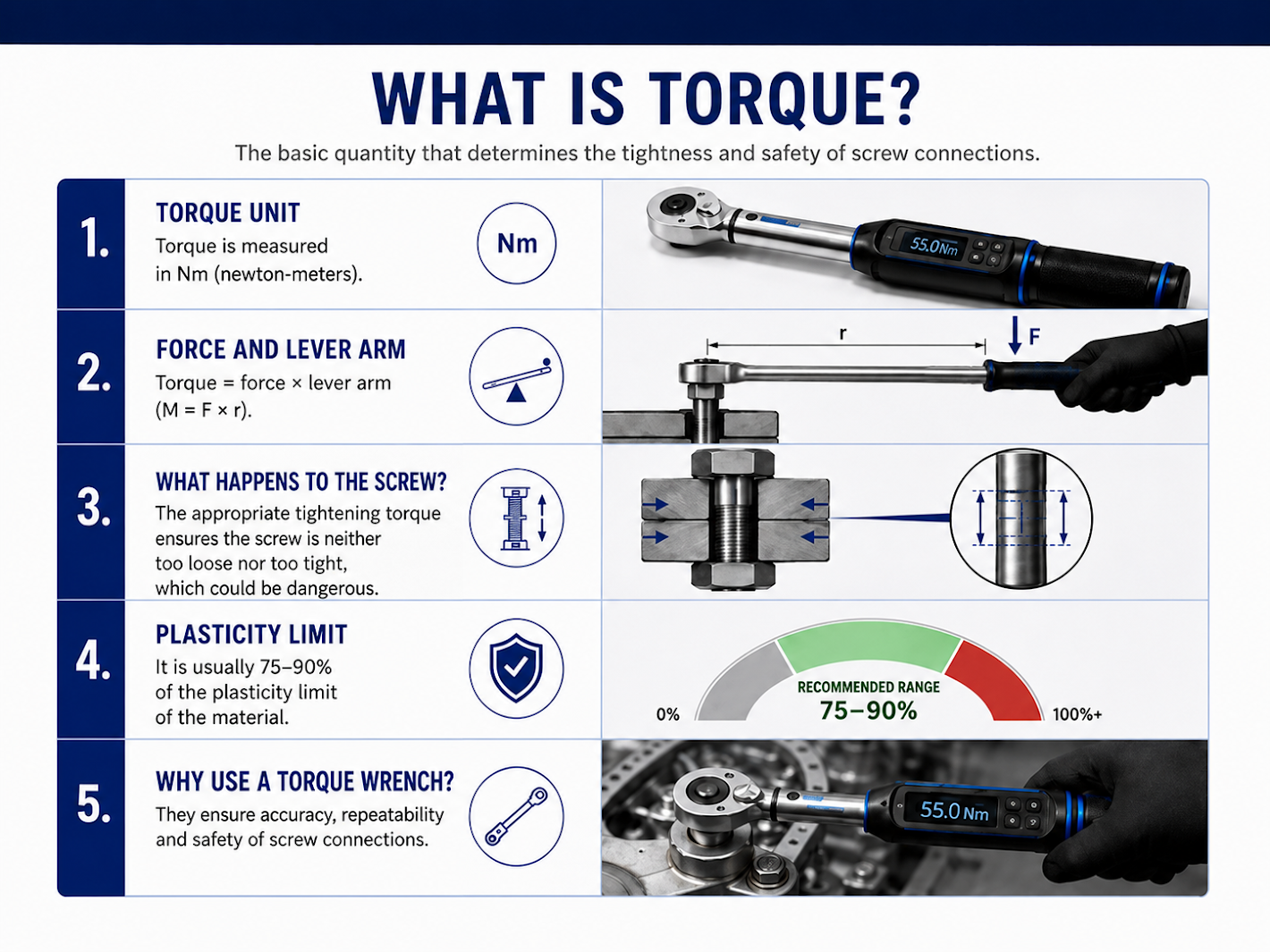
Torque is a physical quantity that, in the SI system, is expressed in units of Nm, and in imperial (Anglo-American) units is denoted as lb.ft or lb.in. In short, it is the quotient of the applied force (N) and the length of the lever arm (m). This value indicates the force that must be applied to a torsional joint to ensure a permanent and secure connection between two components using a fastener, in this case, a screw. During the fastening process, the fastener (screw) undergoes gradual tension, and the force generated acts in the direction of both components being joined, thereby causing them to be permanently clamped together. Each bolt has its own individually defined “yield point” that is, the point beyond which the material from which it is made, undergoes permanent deformation, causing irreversible damage to the bolt. The recommended force required to correctly and safely join two components without damaging the bolt ranges from 75% to 90% of the yield point of a given bolt in a specific grade. To properly make a bolted joint, a precisely appropriate force must be applied, and this is precisely what torque tools enable.
Types of Torque Tools
Torque tools can be divided into two main groups – hand-operated torque tools and power-driven torque tools. Each of these groups is further divided into several sub-groups; a detailed breakdown is provided below:
Hand-operated torque tools
Mechanical torque wrenches – the most common type on the market – are divided into two categories: spring-loaded wrenches, which require the mechanism to be released after the measurement is complete, and rod-type torque wrenches, which do not require the mechanism to be released after use. The required accuracy for mechanical torque wrenches is ±4%, but many manufacturers on the market already offer higher accuracy such as ±3% as standard. Mechanical torque wrenches are the most commonly used torque tools, they ensure a fast assembly process, are easy to use, and require no external power source. Models ranging from 1 Nm to as high as 3000 Nm are widely available.
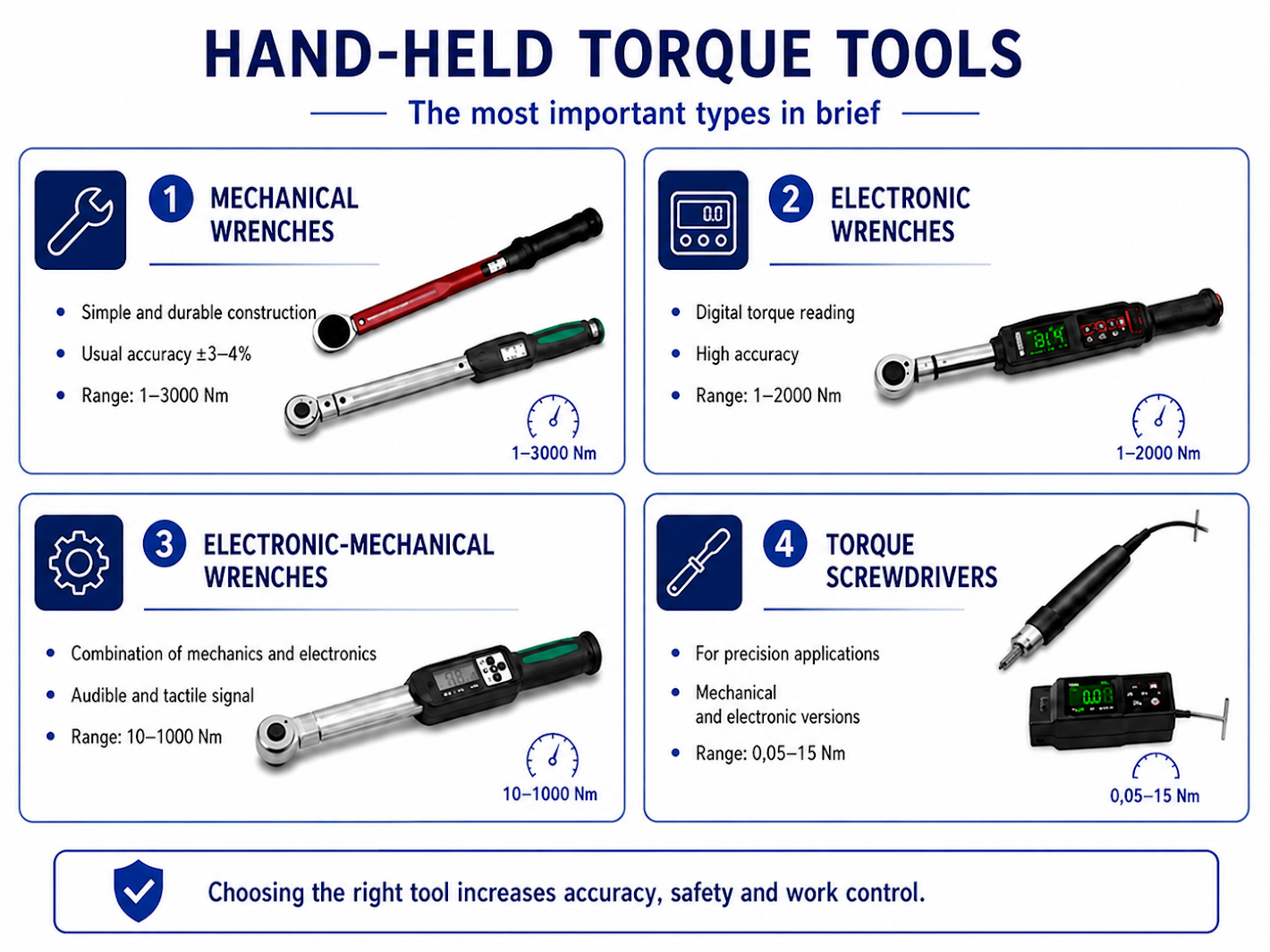
Electronic torque wrenches – within this subgroup, we distinguish between electronic torque wrenches with torque readout and those with both torque readout and angular displacement measurement. The measurement accuracy of electronic torque wrenches is higher than that of their mechanical counterparts
and is typically around +/-2%, but our product line includes models with measurement accuracy of +/-1% - in both clockwise and counterclockwise directions (CW/CCW). Another major advantage of electronic torque wrenches is that they feature internal memory, allowing measurement results to be fully documented and transferred from the wrench via computer communication software, for further analysis or to provide process documentation. Electronic wrenches are most commonly available in the range from 1 Nm to 2000 Nm.
A unique combination of the above types of torque wrenches is the series of electronic-mechanical wrenches like the Stahlwille 730D series. Wrenches in this series signal that the set torque has been reached with a characteristic “click”, but at the same time feature an electronic torque display and internal memory, making it possible to download measurement results to a PC for archiving and further processing.The 730D series wrenches are available in ranges from 10 Nm to as high as 1000 Nm.
Torque screwdrivers – within this subgroup of torque tools, we distinguish between mechanical torque screwdrivers and electronic ones. Mechanical torque screwdrivers are divided into two types – torque screwdrivers with a slip clutch, which make up the vast majority of models available on the market, and torque screwdrivers with a ratchet mechanism – offered by only a few manufacturers.
Most models of mechanical torque screwdrivers feature measurement accuracy of +/-6% in accordance with the guidelines of the ISO 6789 standard. Mechanical torque screwdrivers are most commonly used in the range from 0.05 Nm to 10 Nm.
Electronic torque screwdrivers are tools that offer very high measurement precision up to 1% and typically allow measurement results to be stored in internal memory. For this reason, they are the tools most frequently chosen for quality control processes, for high-precision assembly, or for various types of research and prototyping work. Electronic torque screwdrivers are most commonly used in the range from 0.05 to 15 Nm. https://torqueshop.eu/electronic-torque-screwdrivers
Within this group of torque tools, there is another subcategory – electromechanical torque screwdrivers, which, like electromechanical wrenches, signal when the set torque is reached with a characteristic “click,” but they also feature an electronic torque display and internal memory, making it possible to download measurement results to a PC for archiving and further processing.
Powered torque tools
This group of torque tools includes all tools with electric or pneumatic drives.
Pneumatic torque screwdrivers – these are all torque tools that use a pneumatic drive. They may be equipped with slip clutches or the much more precise cut-off clutches. They are commonly used on assembly lines and are characterized by ease of use and resistance to harsh operating conditions.
Pneumatic torque screwdrivers are available in torque ranges from 0.4 Nm to 15 Nm in straight or pistol-grip versions, but in the angle version, their maximum torque range can be significantly higher – up to 150 Nm. It is important to remember that, in accordance with health and safety regulations, when using straight-handle screwdrivers with torques exceeding 5 Nm, it is necessary to use reaction arms, to protect the operator’s health. The accuracy of this type of torque tool ranges from 10% to 15%. A separate category among pneumatic screwdrivers is impulse-type screwdrivers – thanks to their unique design, featuring a built-in chamber filled with special oil, they prevent the transfer of centrifugal force to the operator’s arm during the tightening process, allowing for very high torque values – up to 400 Nm – without the need for reaction arms, their accuracy ranges between 10% and 15%.
Electric torque screwdrivers – this is a very broad and diverse group of torque tools. What they have in common is that they are powered by electric motors, but beyond that, the differences between them can be quite significant. Electric torque screwdrivers can be powered by standard brushed motors or modern
brushless motors – which require no maintenance or servicing. They can be equipped with either slip clutches (now rarely used), precision cut-off clutches that ensure 10% accuracy under real-world operating conditions, or torque control based on strain gauge sensors – a solution that allows for accuracy ranging from 3% to 5%.
This type of torque tool is widely used on production lines, ensuring fast assembly combined with precise process control, communication with a PLC is typically a standard feature of these torque tools, and more advanced models can connect in real time to data collection systems, guaranteeing compliance with very stringent assembly requirements.
Electric and cordless torque wrenches –these are torque tools designed to handle high torque values – up to 15,000 Nm! They are intended for heavy industry, steel structure assembly, and various types of maintenance work. In this tool category, we distinguish between mains-powered torque wrenches and cordless torque wrenches. Both types of torque wrenches are available in both straight and angle versions, allowing for easy achievement of high torque values while maintaining very high accuracy - +/-3.5% for corded torque wrenches and 4% for cordless torque wrenches.
Hydraulic torque wrenches – this is perhaps the narrowest yet most remarkable category of torque tools. They allow for the application of very high torque values, even up to 70,000 Nm! However, it is likely possible to achieve even higher values with tools custom-designed to meet specific customer requirements. They are available in a socket-type version – with a drive for mounting sockets, and also in a cassette-type version – whose highly valued advantage is its compact design – allowing for use in the most challenging applications, especially where space is limited and high torque is required for the bolted
joint being tightened.
Pneumatic torque wrenches – these are tools that use a pneumatic drive to achieve high torque values. They require the use of an additional compressed air supply station, which makes them a relatively rarely chosen torque tool, and are primarily used where the use of electric torque wrenches is limited – for example, in the petrochemical industry. Their advantage lies in their ability to achieve high torque values – even up to 15,000 Nm – and a high 5% accuracy.
Where are torque tools used?
Torque tools are currently used in a very wide range of applications, in fact, it is difficult to find an industry where they are not used. Of course, they are most commonly used in the manufacturing industry in the broadest sense – in factories and assembly plants, especially in the automotive industry – for the production of car components and assembly processes, but also in the food industry – for example, to adjust moving machine parts; in the woodworking industry – to adjust saw tension, in the petrochemical industry – for all kinds of machine adjustments, in machine and equipment maintenance, in auto repair shops and in construction – for the assembly of steel structures. Torque tools are also very commonly used in the medical industry – for assembling critically important parts of medical devices – as well as in situations and places that rarely come to mind in the context of torque tools – for example, in hospitals during joint replacement surgeries, and in dentistry – for the placement of dental implants.
The safety and even the lives of millions of people depend every day on the use of properly functioning torque tools – a very good example of this is the aviation industry – where all critical bolted joints are tightened using the appropriate torque tool, and few people realize that even the covers of runway lighting fixtures must be tightened and regularly inspected using torque wrenches specifically designed for this purpose. The same applies to rail and road transport – the wheels of every vehicle, whether it’s a massive semi-truck, a passenger car, or a motorcycle, should be tightened to the correct torque value – and this can only be guaranteed by using a torque wrench!
In fact, even some components of the computer on which you are reading this article are likely assembled using torque wrenches designed specifically for that purpose.
The Most Common Mistakes When Using Torque Tools
Torque tools, like any other tools, should be used properly and in accordance with their intended purpose. Most often, errors in their use stem from the user’s lack of knowledge. When purchasing what is often their first torque tool, the user is very rarely informed by the salesperson about the basic rules of use (salespeople are often unaware of them themselves), which is why we recommend purchasing torque tools from stores specializing in this field. Common mistakes include:
- Overtightening/breaking the connection – this applies especially to mechanical torque wrenches. It is important to remember that a torque wrench is not a “magic tool.” The wrench will signal that the set torque has been reached with a characteristic click, and at that moment, the operator should stop tightening the bolt. The wrench signals to the operator that the torque has been reached, but if the operator does not release the wrench and continues to tighten the joint, this will result in excessive torque being applied to the joint (over-tightening) or even the joint breaking. This situation occurs most frequently when working with low torque values – joints up to 30 Nm are the most sensitive, and the lower the torque, the greater the risk of joint failure due to careless torque application.
- Leaving the wrench set to a specific torque value – this applies to all wrenches with a spring- loaded mechanism. Keep in mind that after finishing work, the torque wrench mechanism should be released to the minimum value on the wrench’s scale – or, if possible, even slightly below it. Otherwise, the mechanism’s spring will gradually degrade, which over time will result in the wrench malfunctioning.
- Using torque wrenches to loosen connections – Most mechanical torque wrenches are designed for tightening connections, their mechanisms do not rotate counterclockwise and should not be used to loosen connections. Using them for this purpose leads to damage to the mechanisms and, as a result, improper operation of the wrenches, causing significant measurement errors. This is very important because, unlike electronic torque wrenches, mechanical torque wrenches cannot alert the user to damage or the need for calibration, which can lead to a situation where the wrench’s accuracy is compromised by a significant measurement error without the user being aware of it.
- Applying torque at the wrong location – every manual torque wrench – whether electronic or mechanical – has a designated “reaction point.” This is the point where force was applied during the tool’s calibration, and the operator should hold the wrench at this exact point when tightening a joint. This point is usually marked on the wrench’s handle, but not all manufacturers include such a marking – if the wrench does not have one, it is assumed that the reaction point should be at the center of the handle. Applying torque at a different location during tightening will result in change in the achieved torque value.
- Exceeding the maximum torque value specified for a given torque wrench – keep in mind that best practice is to use a torque wrench with an adequate margin below the maximum torque range specified for that model. Using a torque wrench at its maximum torque is, of course, permissible, but consistently operating it this way significantly shortens its service life and makes it much more susceptible to damage.
- Lack of inspection and periodic calibration of torque tools – every torque tool should be regularly inspected and calibrated – unfortunately, we still observe that many users do not give this the attention it deserves, which results in the use of tools that are subject to significant measurement errors.
Calibration and Maintenance of Torque Tools
As we mentioned earlier, all torque tools are subject to periodic inspection and calibration, and proper maintenance significantly contributes to their proper functioning and extends their service life. According to ISO 6789:2017, all manual torque tools should be calibrated either every 12 months or every
5,000 cycles (one cycle is defined as one activation of the wrench mechanism after reaching the set torque value). In the case of mechanical torque wrenches, most users follow the time-based criterion – calibration every 12 months – since it is usually difficult to track how many cycles a given wrench has performed; th exception here are users who employ torque tools on assembly lines, where it is possible to precisely determine how long it will take for the tool to complete 5,000 cycles. For electronic wrenches, it is usually possible to set a reminder in the wrench’s software to perform calibration either after 5,000 cycles or 12 months from the date of the last calibration – wrenches from reputable manufacturers will display a message on the tool’s screen reminding the user of the need for calibration.
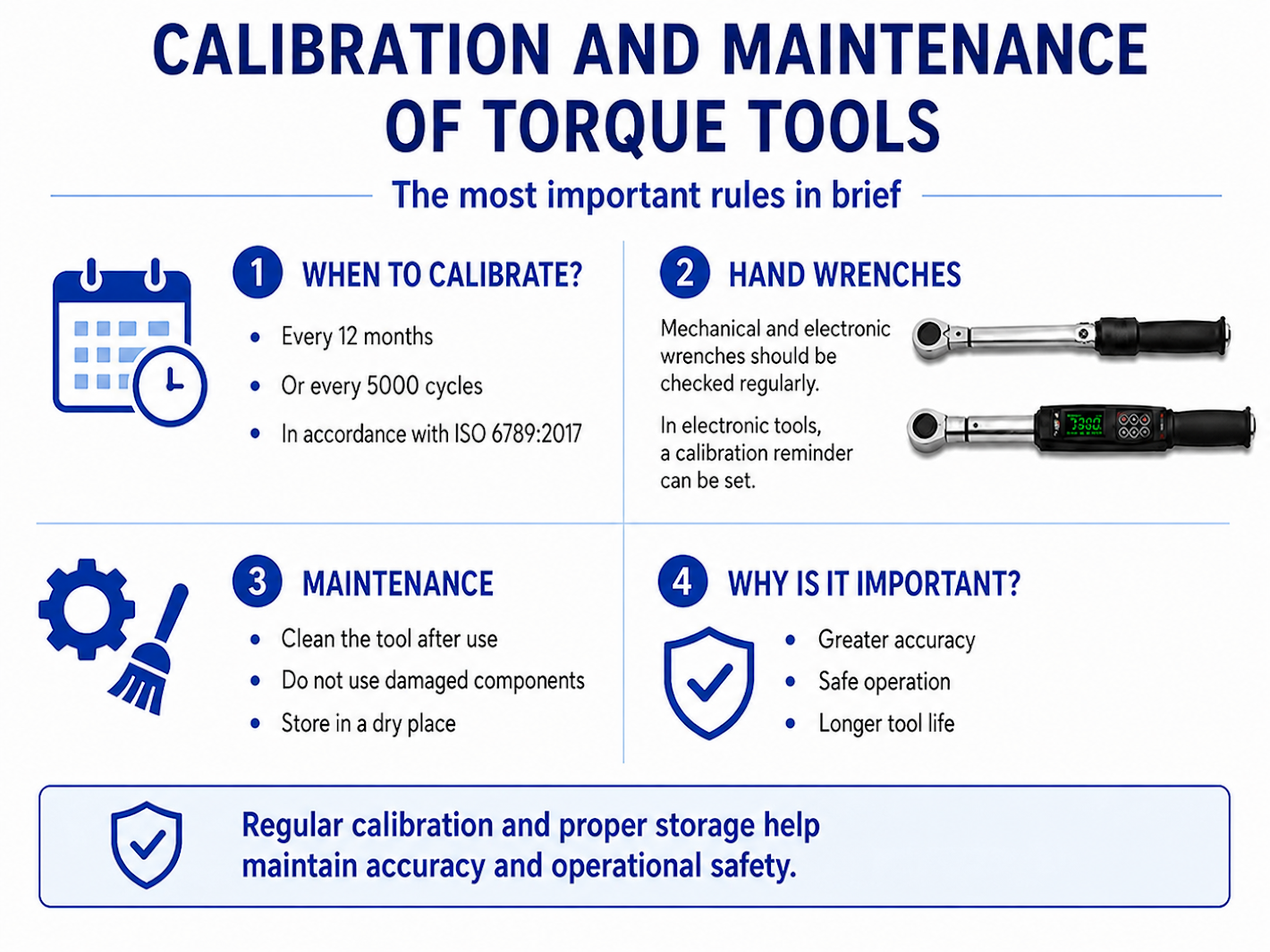
Since the ISO 6789:2017 standard applies to manual torque wrenches, the situation is slightly different for power-driven tools – here, each manufacturer typically has its own guidelines regarding calibration frequency, which can vary widely depending on the type of tool and how it is used.
When it comes to maintaining torque tools, it’s important to keep a few basic things in mind – such as regular cleaning, loosening the mechanisms after use, and replacing damaged components – for example, worn or damaged ratchets, replaceable handle parts, or damaged storage cases for wrenches and other torque tools. It is also important to store them under appropriate conditions – in dry and, if possible, heated rooms – as storing mechanical wrenches at subzero temperatures for long periods can cause lubricants to accumulate on the internal components of the mechanism and lead to malfunction.
How do you choose the right torque tool?
To choose the right torque tool – one that meets our requirements and will serve us for many years – it is important to consider several key criteria:
Determining the maximum torque value we want to apply
The first, and perhaps most important, step is to determine the maximum torque value we want to apply. We recommend selecting a torque tool so that its maximum torque range is ideally 20% greater than the maximum torque we intend to apply – this will ensure ease of use, extend the tool’s service life, and prevent unnecessary failures caused, for example, by consistently operating at the maximum torque rating for a given model.
Defining process requirements
Defining process requirements to select the appropriate type of torque tool. Is simply applying the required torque sufficient – in which case a standard mechanical wrench is entirely adequate – or is it necessary to collect process data and document the applied torque – in which case an electronic torque wrench is recommended.
How intensive will the usage be?
For example, if you’re looking for a torque wrench to tighten wheels after seasonal tire changes and it will only be used twice a year, you can opt for a model designed for workshop applications; however, if the wrench will be used daily, you should choose a torque wrench designed for industrial use.
The Right Manufacturer
Another important aspect is paying attention to the manufacturer’s brand – it’s not about choosing “brand-name” products, but rather that torque tools from established brands that have been on the market for a long time are simply well-made and, most importantly, all replacement parts are available for them – which ensures trouble-free operation and guarantees repairs long after the warranty period has expired. If you choose unknown brands, it’s impossible to repair the wrenches due to a lack of available replacement parts, and they malfunction much more frequently than tools from reputable manufacturers.
Price is not irrelevant
No one wants to overpay for tools, but when it comes to torque wrenches, price does matter. Tools that are very attractively priced, especially those from unknown manufacturers, are usually of very poor quality. You should absolutely never buy any torque wrench that does not come with a calibration certificate, and unfortunately, such tools are still available on the market. On numerous occasions over the 16 years of our company’s existence, we have received torque wrenches from customers for calibration that they had purchased new but lacked a calibration certificate, the vast majority of them were unusable – measurement errors significantly exceeded the permissible tolerance of +/-4%, and adjusting them was impossible.