


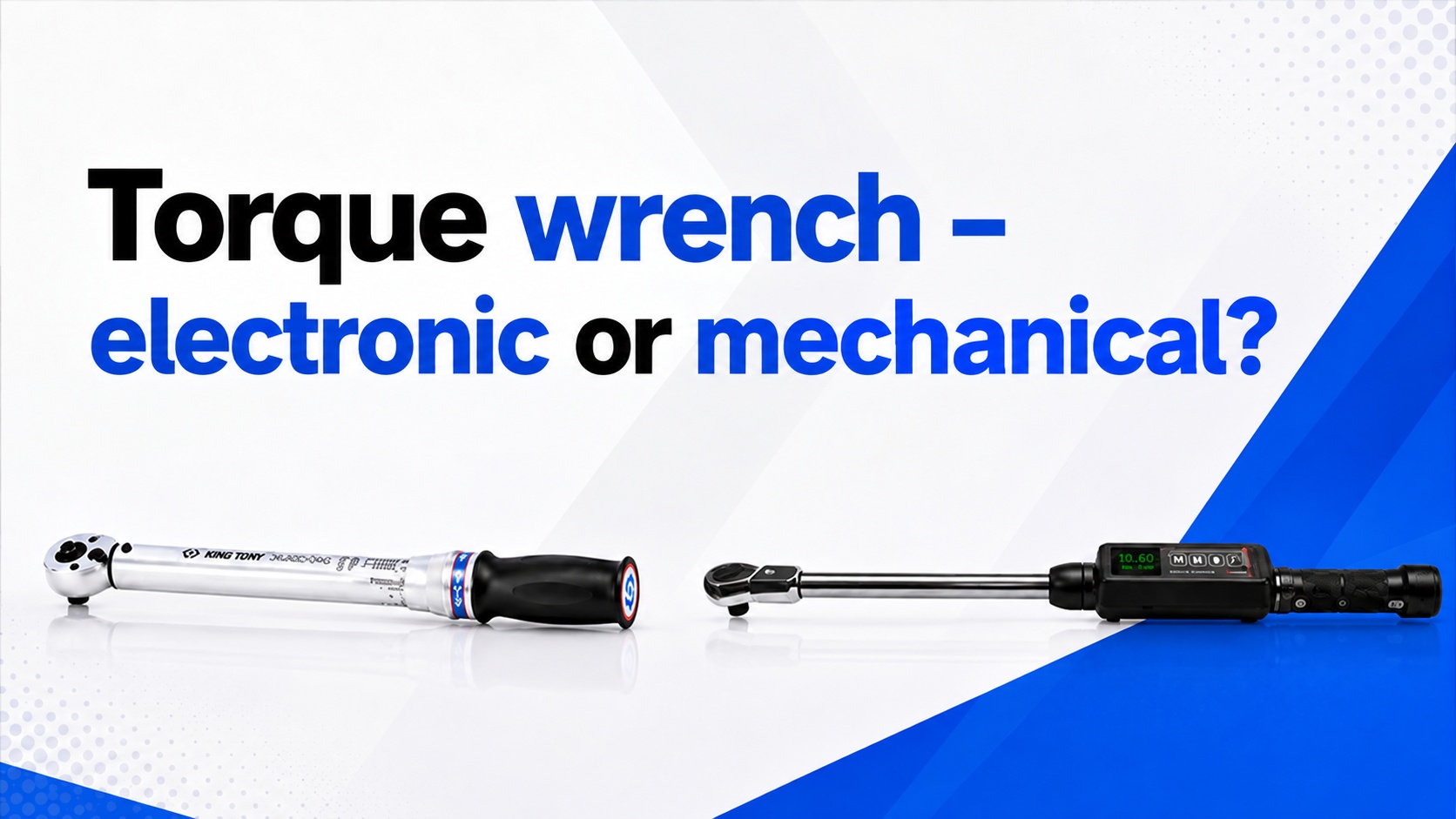
Manual torque wrenches are divided into two types—mechanical torque wrenches and electronic torque wrenches. Mechanical torque wrenches can be further divided into several subtypes:
- wrenches with a spring mechanism - these require manual release after use,
- wrenches with a rod mechanism - these do not require manual release after use.
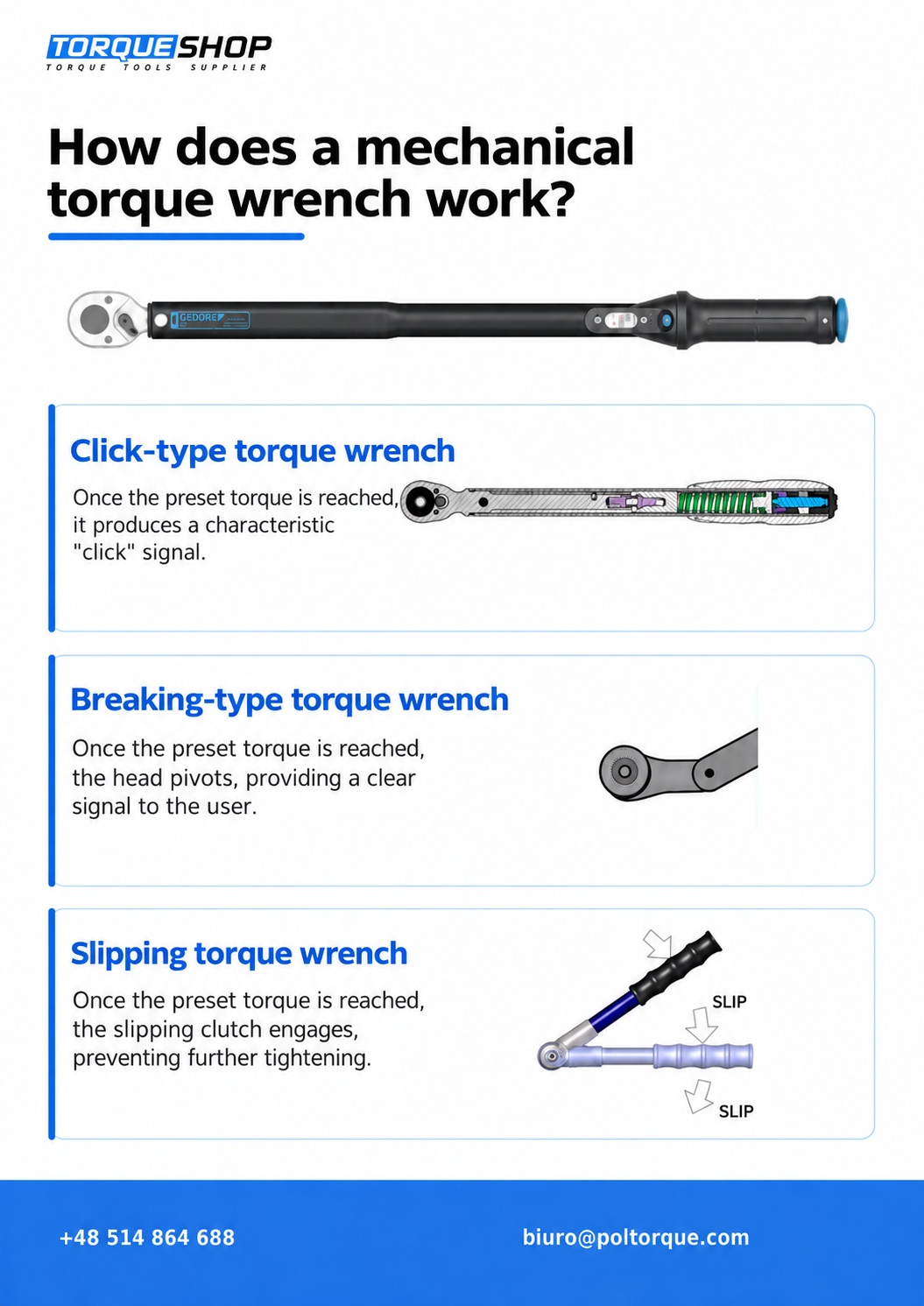
Spring-loaded wrenches can be further divided into additional subcategories based on how they signal that the torque has been reached:
- click-type wrenches - the user hears a distinctive click when the torque is reached,
- bend-type wrenches - the wrench arm bends by approximately 20 degrees when the torque is reached,
- slip-type - the slip clutch engages when the torque is reached.
Mechanical wrenches allow the required torque value to be adjusted either using a scale or by calibrating with a torque wrench tester.
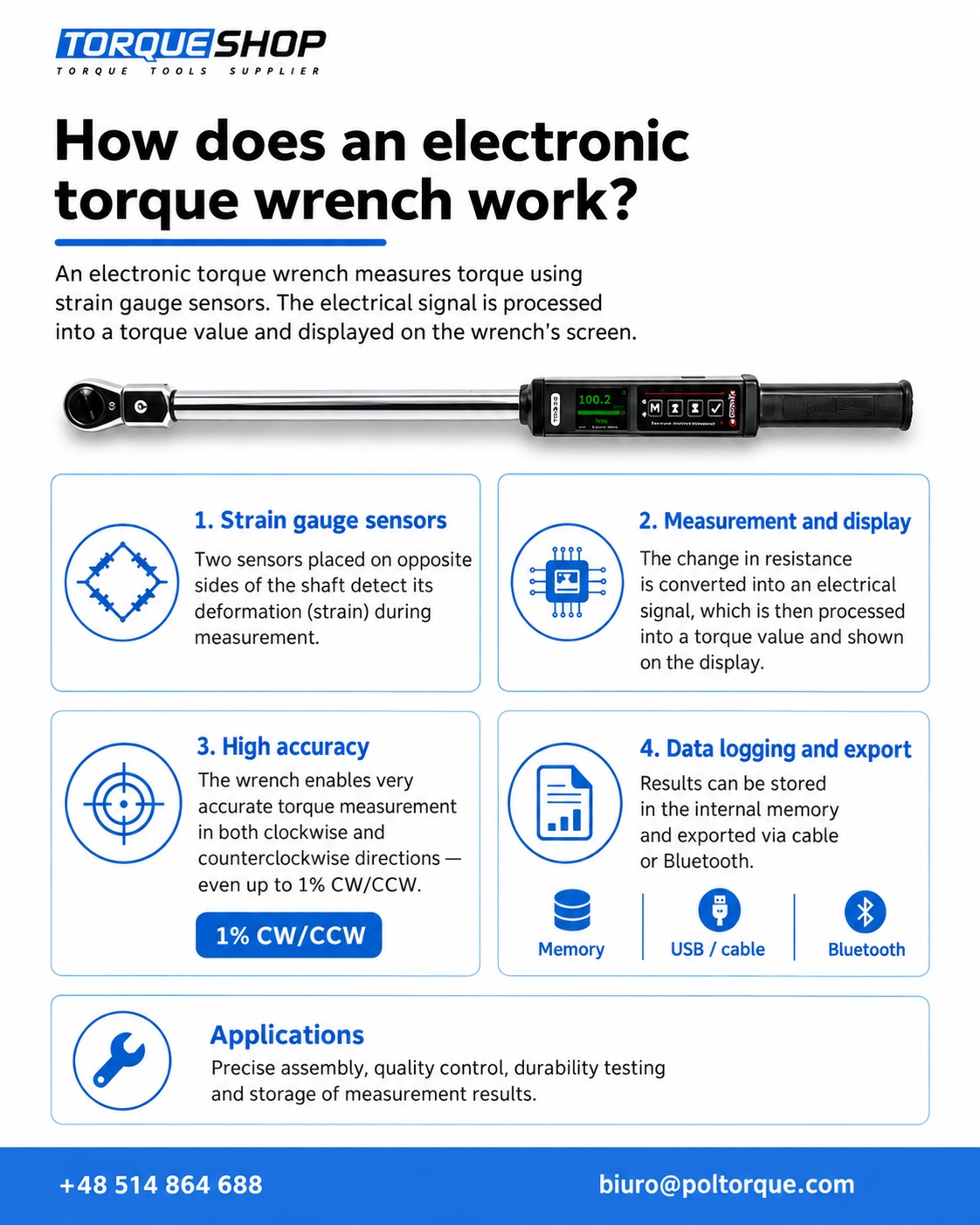
Electronic torque wrenches, on the other hand, operate using strain gauge sensors that transmit measurement data to an electronic circuit, and the measurement results are then shown on the wrench’s display. They enable real-time torque measurements - using the Track function - and peak torque measurements using the Peak function. Unlike mechanical torque wrenches, they are equipped with internal memory that allows you to archive the results, and they offer greater measurement accuracy- up to 1% CW/CCW. Check out BMS Ireland TWS Torque Wrenches.
Electronic torque wrenches are also often available in various configurations, such as models that measure both torque and angle - STAHLWILLE 713R Series - or models capable of communicating with data collection systems via Bluetooth, such as Bluetooth torque wrenches.
Electric torque wrenches and mehanichal ones - comparison
Mechanical and electronic torque wrenches, although designed to perform the same task, are actually very different tools. Below are a few key differences between these two types of torque wrenches.
|
|
Mechanical Torque Wrench |
Electronic Torque Wrench |
|
Measurement Accuracy |
The standard measurement |
High-quality electronic torque wrenches offer an accuracy of +/-1%. However, there are also |
|
Capable of operating in both clockwise and counterclockwise directions (CW/CCW) |
The vast majority of mechanical torque wrenches |
Electronic torque wrenches |
|
Signalization that the target torque has been reached |
The most common solution is a signal in the form of a |
Visual feedback—via changes in the display color— and audible feedback. |
|
Compatibility with interchangeable ends |
Models are available in which |
All high-quality electronic wrenches allow you to change the ratchet head for flat or ring ends |
|
Torque Adjustment |
Torque is adjusted using the |
Adjustment via the keypad or using dedicated software. |
|
The ability to pre-enter (preset) several programs for torque values |
Not possible—mechanical |
The wrench memory can store several or even a dozen or so torque settings |
|
Ability to save measurement results |
Not possible - mechanical torque wrenches do not have |
Electronic torque wrenches are equipped with internal memory |
|
Ability to export data from a wrench |
Not possible |
High-quality electronic wrenches allow you to transfer measurement results stored in memory-either via a cable connection or wirelessly via |
Mechanical Torque Wrench - Advantages and Disadvantages
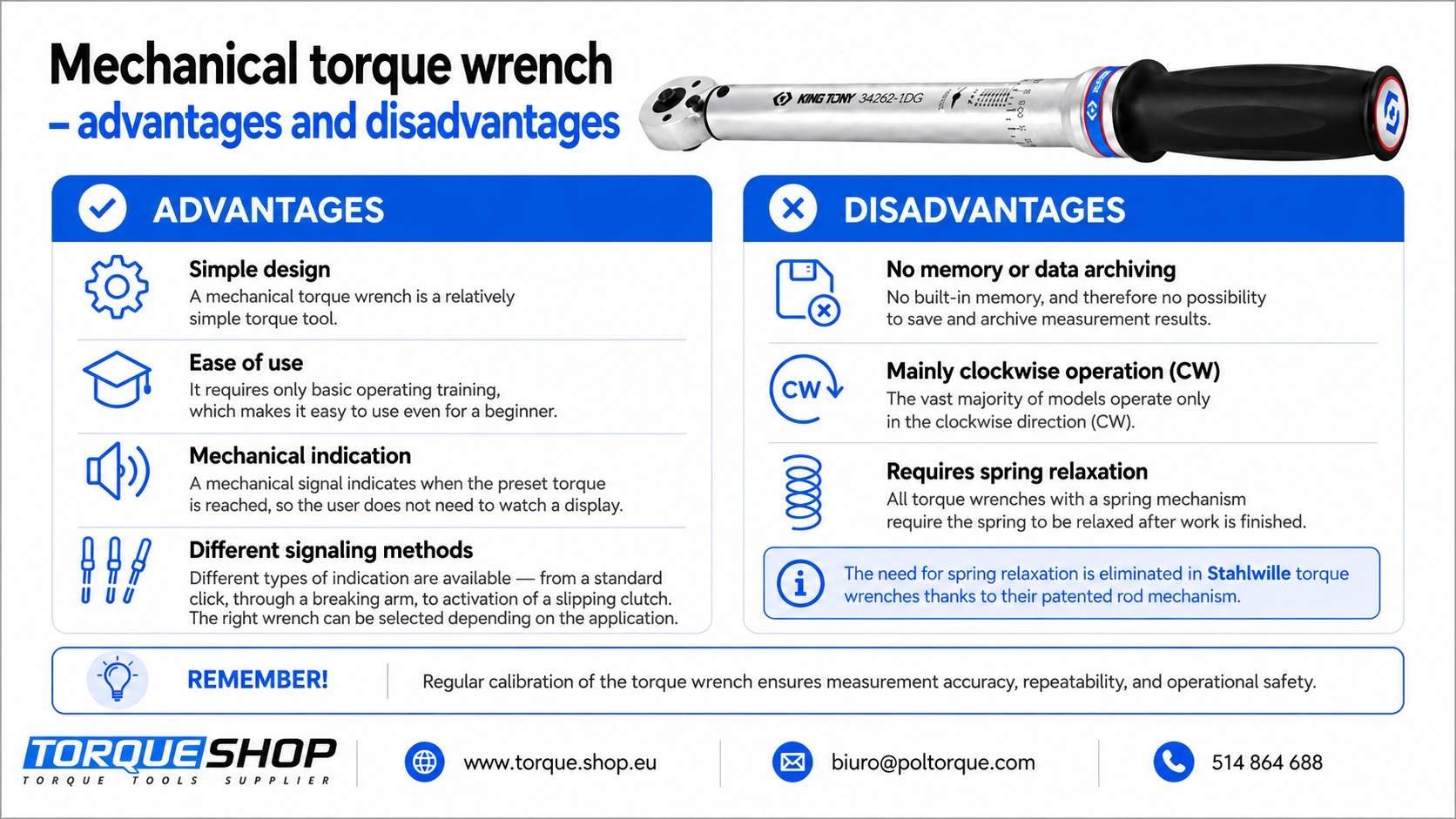
A mechanical torque wrench is a relatively simple torque tool. It requires only basic training to use, making it easy to operate even for a novice user. A major advantage is the mechanical indication when the set torque is reached, which means the user does not have to watch the display. Mechanical torque wrenches offer several types of feedback—from a standard click, to arm deflection, to the activation of a slip clutch—so the appropriate feedback method can be selected based on the customer’s needs.
The main disadvantages of mechanical wrenches include the lack of memory—and thus the inability to record and archive measurement results—as well as the fact that the vast majority of models operate only in the clockwise (CW) direction. An additional drawback is that all torque wrenches with a spring mechanism require manual release after use.
Electronic Torque Wrench—Advantages and Disadvantages
The greatest advantage of electronic torque wrenches is their high measurement accuracy, as well as the ability to store measurement results in internal memory and then archive them in data collection systems. These wrenches also allow for torque measurements in both clockwise and counterclockwise directions and do not need to be loosened or otherwise secured after use. A major advantage is the ability to monitor torque in real time—which makes them ideal tools for research facilities. Another important benefit of electronic torque wrenches is the availability of models with wireless communication, allowing them to be easily integrated into industrial production line applications where communication with other devices is required—such as communication with a PLC.
A disadvantage of electronic wrenches is the lack of mechanical feedback; in most cases, the operator must watch the display or rely on audible signals. Care must also be taken with the display, which can be damaged by careless use. To some extent, the price can also be considered a disadvantage of electronic wrenches —models from reputable manufacturers are usually 2–3 times more expensive than their mechanical counterparts.

Which torque wrench should you choose? The most important evaluation criteria
To ultimately make the best decision, you should consider several basic criteria when selecting torque wrenches:
Is it enough to just confirm that the minimum required torque value for a given joint has been achieved?
If that is the main requirement, then a standard mechanical torque wrench will be suitable.
Is it necessary to archive the measured results?
If this is a requirement, you’ll need to purchase an electronic torque wrench—only this type of wrench stores results in its internal memory and allows for further processing or archiving.
What is the required accuracy of the torque wrench?
If an accuracy of +/-4% is acceptable, a mechanical wrench will suffice; however, if an accuracy of 1–2% is required, an electronic torque wrench is necessary.
Do you need to monitor torque in real time?
If so, an electronic torque wrench provides this capability; with a mechanical torque wrench you will only receive confirmation that the torque value set on the wrench has been reached.
Do we want to precisely determine the peak torque or breakaway torque?
When determining the maximum torque achieved on a given joint, or when you need to determine, for example, the breaking torque for a given joint, the best choice is an electronic torque wrench. Operating in Peak mode, the wrench allows you to determine the maximum torque achieved during tightening and save this value in its internal memory.
Summary
Mechanical and electronic torque wrenches, although theoretically designed to perform the same task, are —due to differences in their construction—essentially completely different tools, intended for very different applications. The selection of a specific wrench model should be preceded by an analysis of the requirements of the specific application and the user’s budget.
At our company, we always review each inquiry individually and strive to select the best tool for our customers’ specific needs, so that every joint is properly tightened while maintaining the required precision and other necessary criteria—but at the same time, ensuring that the customer does not unnecessarily overpay for a wrench whose capabilities they will not be able to utilize or do not need at all.