


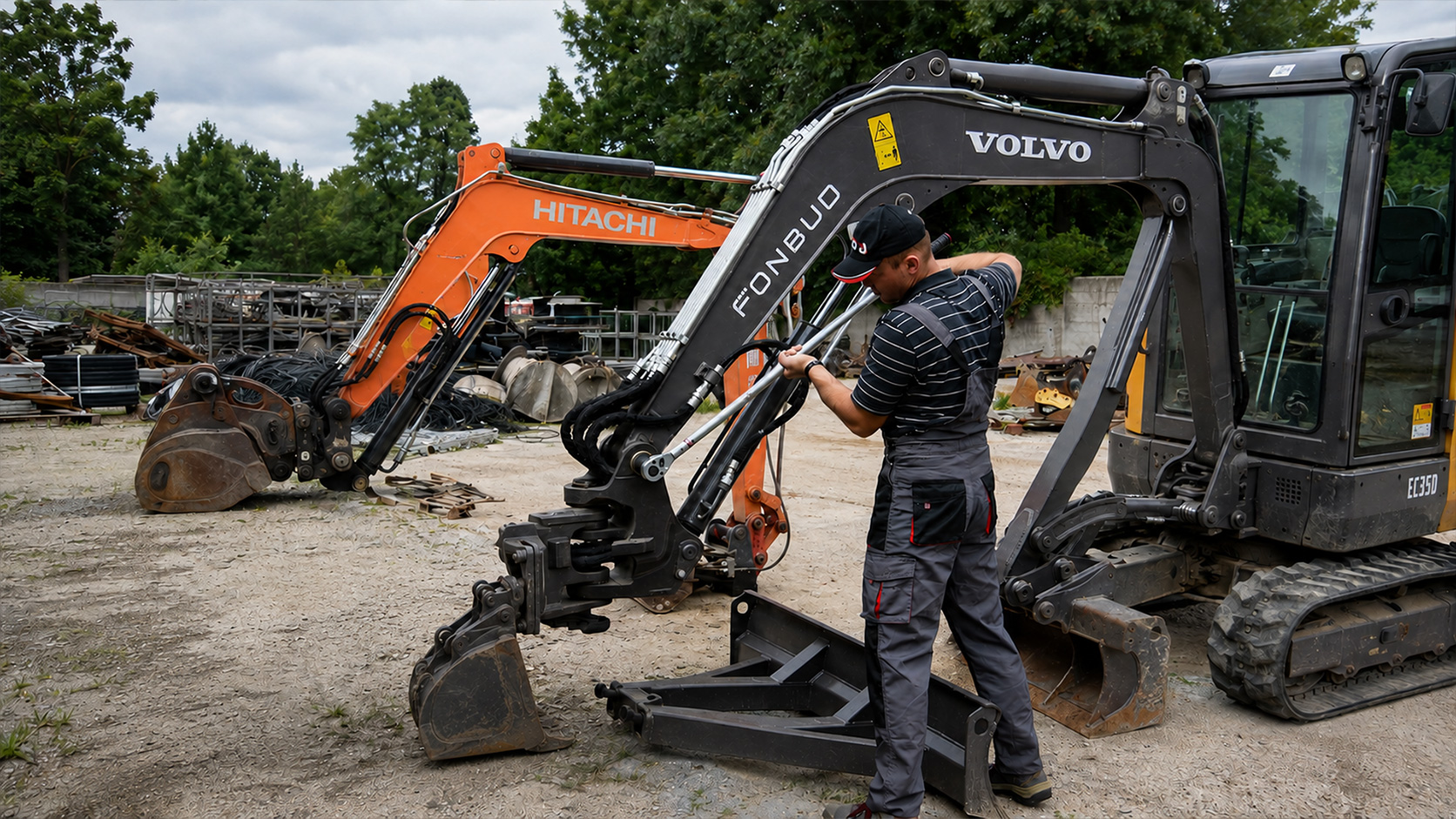
Why should you tighten bolts with a torque wrench?
Today, more and more joints of all kinds have a precisely specified torque value to which they must be tightened, and the only way to be sure that the required joint parameters are met is to use a properly functioning torque wrench.
It is not possible to ensure the correct torque on a joint without a torque wrench. Tightening "by feel" will never give the user the precision or repeatability required, especially when tightening critical joints.
How does a torque wrench work?
A torque wrench informs the user when the required torque value has been reached during tightening. Depending on the type of mechanism, the wrench can signal this in several ways. Mechanical torque wrenches most often signal that the torque value has been reached with a characteristic click. It occurs when a metal pin is released from a spring-loaded seat and strikes the inner wall of the wrench housing. The pin is released when the user applies enough force to the wrench arm to balance the force with which the mechanism's spring presses on the seat holding the pin. The user can set the required torque directly on the wrench scale or, in the case of wrenches without a scale, using a torque tool tester.
In electronic wrenches, a strain gauge sensor transmits information about the torque being reached, which is then shown on the display.
The situation is similar with dial torque wrenches, in which the torque is read from the position of the pointer on the dial.
How do you prepare a torque wrench for use?
Every torque wrench must be properly prepared to do its job well.
With mechanical wrenches that have a scale, the most important thing is to correctly set the required torque value to be applied during tightening. Make sure you set the torque value in the correct unit of measurement, as wrenches very often have scales in two units, e.g. Nm and ft.lb.
With electronic torque wrenches, the required torque value is set either via the wrench keypad or via dedicated software for communicating with the wrench. Choosing the right function for the job is also important. The Track function measures torque in real time, but it resets automatically after the measurement ends, so the result cannot be saved to the internal memory. If the result needs to be saved, select the Peak function from the wrench menu.
With dial (pointer) wrenches, make sure the memory pointer is in its starting position. An incorrect pointer position before measurement can prevent a correct reading of the torque applied during tightening.
Torque wrenches without a scale should be checked with a torque tool tester before use to make sure the set torque meets the requirements of the specific application.
How to tighten bolts correctly with a torque wrench: step-by-step guide
Once the wrench has been properly prepared, you can start work.
Most joints can be made with standard sockets. Choose a socket of the correct size and fit it onto the drive square of the wrench ratchet. If the joint requires open-end or ring-end insert tools, select the correct size and fit the insert tool into the wrench adapter.
Remember that the user should hold the torque wrench in the correct place. Some wrenches have a mark on the handle showing where to grip, but if there is no such mark, it is considered good practice to hold the wrench in the middle of the handle. An incorrect grip position can affect the torque value achieved.
Torque should be applied smoothly and steadily, without unnecessary jerking, and the user should stop tightening as soon as the wrench signals that the set torque has been reached. Continuing to apply force after the wrench has signalled will exceed the set, desired torque value. Do not repeat the tightening. Applying the torque once is enough, and every repetition increases the risk of applying too much torque to the joint, which may damage it.
What torque should bolts be tightened to? Application examples
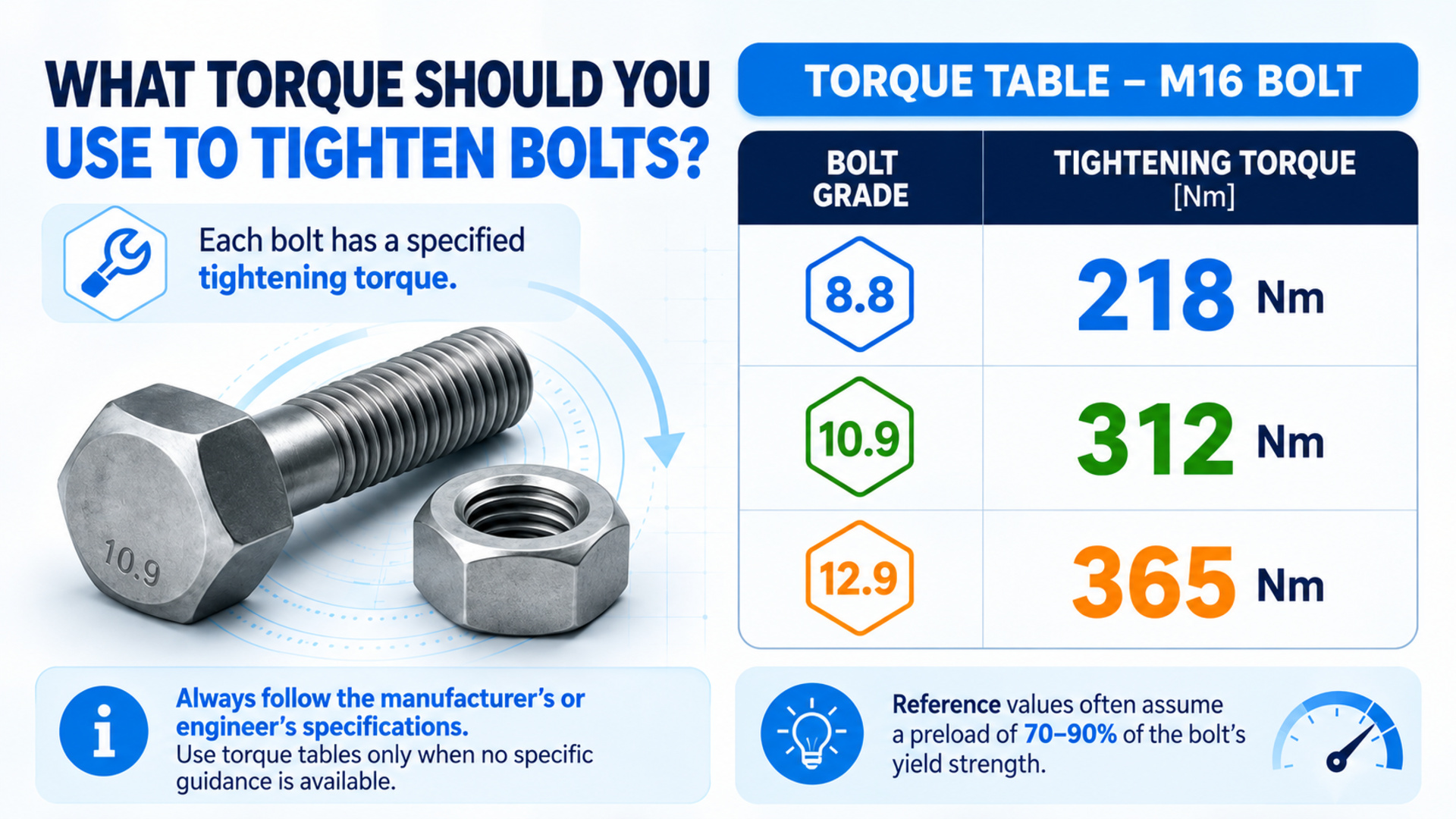
Every bolt has a specific individual torque value to which it should be tightened. This value usually ranges from 70% to 90% of the yield strength for a given bolt size and property class. Torque tables with recommended values for individual bolt sizes in specific classes are widely available. It is important to consult the documentation for the joint being made, as it defines the recommended torque, which may for example be lower than the value given in the table for that bolt. For instance, an M16 bolt in property class 10.9 requires 312 Nm, but the same size made of plastic and used, for example, to mount various kinds of clamps will be tightened to only a few dozen Nm.
When tightening, the user should always first follow the guidelines specified by the designer or manufacturer. Only if there are none, or if the technical documentation for the equipment does not exist or has been lost, should a torque table be used.
The most common mistakes when tightening with a torque wrench
Torque wrenches, like any other tool, must be used correctly, and the user can easily make a few mistakes when working with them. We present them in the table below.
|
Incorrect use |
Resulting effect |
|
Incorrect torque setting on the wrench scale |
The torque achieved does not match the specification for the joint: it is either too high and may damage or break the joint, or too low and does not provide sufficient clamping force. |
|
Wrong choice of wrench range |
The wrench range is unsuitable for the work and makes it impossible to apply the required torque value. |
|
Incorrect grip |
The user holds the wrench in the wrong place, which changes the torque value achieved. |
|
Not releasing the wrench mechanism |
The user does not release the wrench mechanism after work, which gradually degrades the properties of the mechanism's spring and affects the torque value achieved. |
|
Using a torque wrench for loosening |
The vast majority of mechanical torque wrenches work only clockwise, and using them for loosening can cause immediate damage to the mechanism. |
|
Using unsuitable insert tools |
Using non-standard insert tools, or ones made to a customer's individual requirements, requires appropriate adjustment of the wrench. Non-standard insert tools with an extended shank affect the torque value achieved. |
Can you loosen bolts with a torque wrench?
Torque wrenches are designed for tightening bolts and should not be used to loosen or undo joints. Most mechanical torque wrenches work only clockwise, and using them for loosening can result in immediate damage to the mechanism. Bear in mind that mechanical wrenches cannot inform the user that they are damaged, so the user may continue using a damaged wrench with a large measurement error without being aware of it.
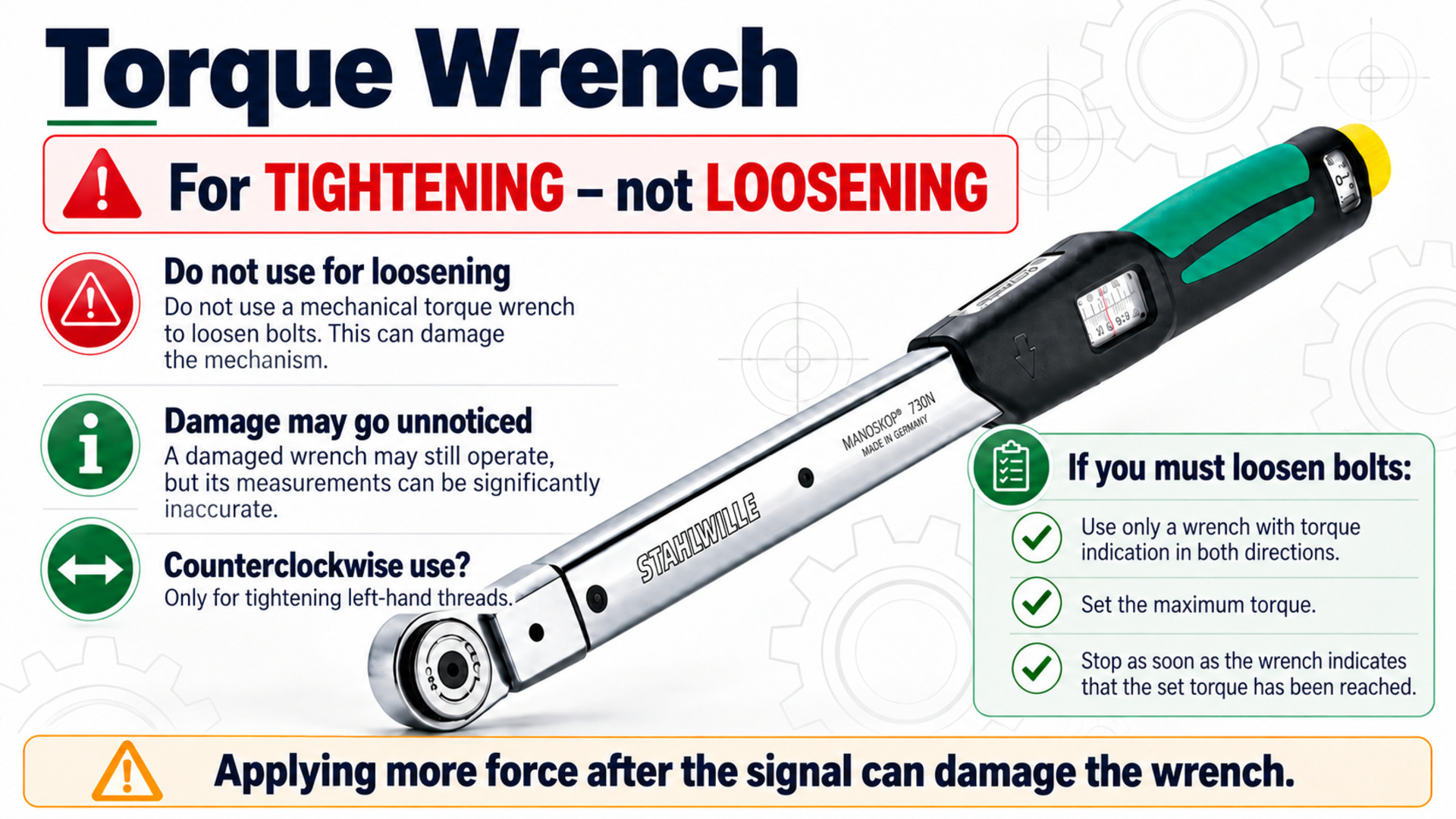
For torque wrenches that can work both clockwise and anticlockwise, we also recommend using them anticlockwise only for tightening left-hand threads. If the user absolutely must use a torque wrench for loosening, this is possible and acceptable only under certain conditions:
- the torque wrench works both clockwise and anticlockwise. This does not refer to the ability to change the direction of the ratchet itself, but to signalling the torque in both directions and having a calibration certificate for both clockwise and anticlockwise operation.
- for loosening, set the maximum torque on the wrench scale, then apply force until the bolt loosens or comes undone, or until the wrench signals that the maximum set torque has been reached. Stop loosening immediately if the wrench signals that the maximum torque has been reached, as further loading of the wrench may damage the mechanism.
How should you store a torque wrench after use?
Every torque wrench with a spring mechanism should be stored with the mechanism released, by setting the scale to the minimum permissible torque value for the model. Like other tools, torque wrenches should also be cleaned after work. In particular, we recommend removing grease and oil residues, which can have a negative effect on plastic parts of the wrench, for example by deforming them, or can compromise safe use and make it harder to grip the wrench properly, which may lead to injury.
You will find more information on storing torque tools in the article How to store torque tools so they do not lose accuracy
Which torque wrench should you choose for your applications?
Choosing a torque wrench to suit your needs requires analysing a few basic criteria:
- Choose the right torque range – anyone buying a torque wrench should first analyse what torque values they will need to apply. Torque wrenches have precisely defined torque ranges in which they operate and cannot be used to tighten joints below the minimum or above the maximum torque value specified for the particular model.
- Pay attention to the size of the wrench – torque wrenches should be selected to meet the requirements of the specific application. For example, if you need to tighten a cylinder head in a car to 70 Nm, a shorter 20–100 Nm wrench is a better choice than a much longer 60–300 Nm one. If you need to use a wrench at height with a torque of 300 Nm, it is better to use an 80–400 Nm wrench, which will be much shorter and lighter than a 100–600 Nm wrench.
- Check whether you will need open-end insert tools – torque wrenches most often come with a permanently fitted ratchet, but versions are also available in which the ratchet can be replaced with open-end or ring-end insert tools. Remember that a permanently fitted ratchet cannot be replaced with insert tools.
- Check the wrench documentation – make sure the wrench you want to buy comes with a calibration certificate. Do not buy wrenches without a certificate: they are very low-quality tools and there is no guarantee that they work correctly. If such wrenches fail, they cannot be serviced or calibrated.